My co-leader and I developed the below activity during our Carpe Diem Education semester trip to SE Asia. These activities really only require two full (plan for two hour) sessions. I hope you find them useful!
Note: All graffiti art below are copies of original pieces done illegally on public/state property around the world by Banksy
Service & Activism: A Semester-Long Inquiry
Materials / resources needed:
- True Meaning of Radical Podcast–Dirtbag Diaries
- Andrea Gibson Podcast, Available on iTunes , “Evolution”
- Banksy Street Art Google Images printed (3)
- What is Service Activity (1 copy for each member of group)
- TED Talk; Everyday Leadership by Drew Dudley
- Blank paper and envelopes for letter to self (to be sent in 6 months by you!)
Topic/s covered:
- Different types of service and activism
- Ways to be engaged and serve your community
- Widening students’ ideas of what service is and how many different ways they can serve (via art, poetry, environmental, direct, lifestyle, vocational, charity/philanthropy, citizenship, social entrepreneurship.
- The importance of being an activist within yourself (challenging your own biases/ideas before striking out to change others’)
Lesson
First Half 1) Independent Journaling We gave students ten minutes to answer the following questions in their journals
- What is activism?
- Identify one cause you are passionate about and the most effective way to enact change
2) Listen to True Meaning of Radical http://dirtbagdiaries.com/true_meaning_of_radical, the story of Chelsea Gerlach, a woman who tried to do right but discovered the validity of an age-old truism — “You can’t fight fire with fire.? Very emotional and inspirational. 
- We split the group in half and had small group discussions about the podcast and then came together as a larger group to talk about activism.
- Questions for small groups were:
- How did your views on activism change?
- Does the end justify the means?
- To what extent?
3) Second part: hand out the reading When Things Fall Apart by Chodron, Pema on Widening the Circle of Compassion (available below). – Students read this article and we then facilitated a discussion regarding the reading relating it back to activism reflecting back on the Podcast.
- What does it mean to be an external vs. internal activist (fighting for causes outside of or within yourself?)
- How does compassion relate to activism?
- What is the author saying that Chelsea did not think about?
4) Activity Andrea Gibson Beat Poet: Give her brief bio {4th time grand slam poetry champion who lives in Boulder, Co… Her poetry focuses on gender, politics, activism, and the struggles disenfranchised populations face in todays world. Gibson disclosed that she chose to write what was in her bones, and thus these subject matters are what came out. On top of using poetry to express what she feels and provide social and political commentary on real issues, she is involved with many activist groups.
Listen to the slam poetry session titled “Evolution” (available on iTunes).
End the session with this poem, which is a remarkable statement about fighting the biases/discrimination/hate within yourself before trying to change others
Second Half ( facilitated during last week of trip) 3) What is Service Activity Available (here). Give each student a copy of this activity and have them list from 1 to 16 what they view as “most” to “least” service. Then break students into small groups and have them share, finding similarities, differences and general observations. Report out (we did groups of three and asked three questions of each group so everyone spoke)
- What are your general observations?
- What were your similarities and differences? Top three and bottom three same/different?
- What criteria did you use? Did anyone think any of these were not service?
The discussion got pretty heated with students trying to argue for their top and bottom picks. We then moved the discussion towards the idea that the point of this activity is actually that everyone does have different ideas and that is GOOD because the world needs all types of service!! If everyone adopted a child but nobody fought for the environment, or if everyone served food at a soup kitchen but nobody donated $50 to the Red Cross, it wouldn’t work! Main talking points:
- Choose a service activity that works for YOU and aligns with your values!
- Find service that is RECIPROCAL! We don’t want to be white knights riding in to save the day as this top-down approach can REINFORCE oppression and inequality, not work to eradicate it!
- Ask the question: Does service have to be altruistic?
- We made the point that it is GOOD if you get something out of it because it means that you will be more committed to that organization and actually make a difference. Find service work where you are benefiting!! This is not a bad thing! For instance, if you want to work on public speaking skills, volunteer at a school; if you want to enhance your editing skills, help write a newsletter for a non-profit, etc. Service work should be TWO WAYS!!!
- Who has done service that was a drag? What was it? Was it just for a day?
- Often students get a bad intro to service as it is obligatory in high school or they do it for a resume and end up picking up sticks or trash for a day. Discuss the difference in short term and long term commitments. Often, when you just volunteer for a day you are a “warm body” doing work that is mindless and does not require training. If you want to really get something from service, volunteer on a regular basis and bring your skills and interests!! This will benefit both you and the organization
4) Banksy: See if any student has any idea on who he is and if possible have the students come up with his bio as many of them are familiar with him. If not, share bio below. Flash images one at a time by Banksy and have students do a quick individual 30 second journal about what they think his message is. Then ask them what they think he is trying to convey. Share as a group. Finally, read the explanation below.
Bio: Banksy is undoubtedly the most controversial street artist to emerge on the global stage. The fact that his identity remains unknown after 20 years on the graffiti scene only adds to the intrigue that surrounds his work. The works of Banksy have appeared in America, Australia, Canada, England, France, Israel, Jamaica and Palestine. Wherever Banksy goes, he makes an impact. His pictorial and satirical messages cross the boundaries between art, philosophy, politics, sociology, humor and narcissism.Banksy is the godfather of a new form of pop art that originated on the street. He used a foundation created by peers to spread powerful messages using accessible street art. Anyone can see Banksy’s stencil art, which enables him to reach a large audience and to make strong statements. City officials have the power to paint over works or allow them to stay. Even when his ephemeral art is destroyed, it draws attention to political issues.
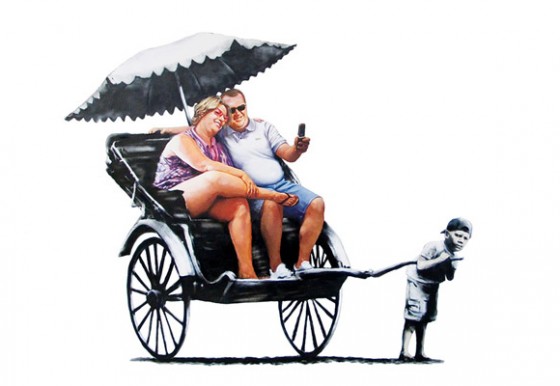 Obesity & The Richshaw Banksy’s message through this painting is very obvious, much like all of his other work. The two obese people sitting in the rickshaw represent the thousands of negative aspects about white America. They are thrilled to be where they are, with a tiny, weak, African American boy hauling them around the city they are visiting. Banksy uses the obesity of the tourists to show the way society has let go of what being healthy is and how privileged American society has become with its convenience. The boy is there to show how some are still obviously suffering while the privileged mock those who are. The people in the rickshaw are shoving their advantaged lives into the face of the disadvantaged, such as camera phones and pink pedicures. The young boy is obviously unhappy in the painting while those being pulled along are joyous about their situation. While they have no sympathy for what they are doing, Banksy knows that his audience is appalled at the sight, but they are not willing to do anything about it. This is what Banksy sees as a problem with society today.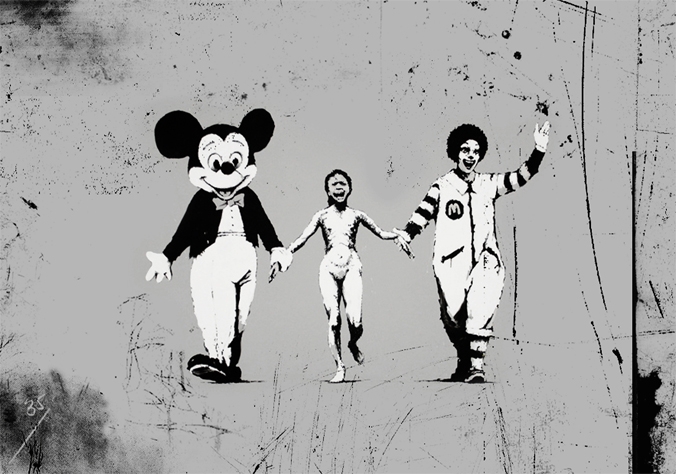
Napalm Girl with Mickey & Ronald McDonald: This satirical work is an attack on the consumerism that occupies the attention of the American people and keeps them blind to the way their foreign policy is conducted. It also points to how consumerism keeps the population blind to more pressing concerns generally. History provides numerous examples of populations that have been pacified with entertainment to distract them from social injustices. Banksy also invites the observer to ponder the commercialization of war itself, which is now a multi-billion dollar industry with very powerful corporate lobbies. Peace, love and empathy for fellow human beings are the sustenance of life, and these things cannot be bought.
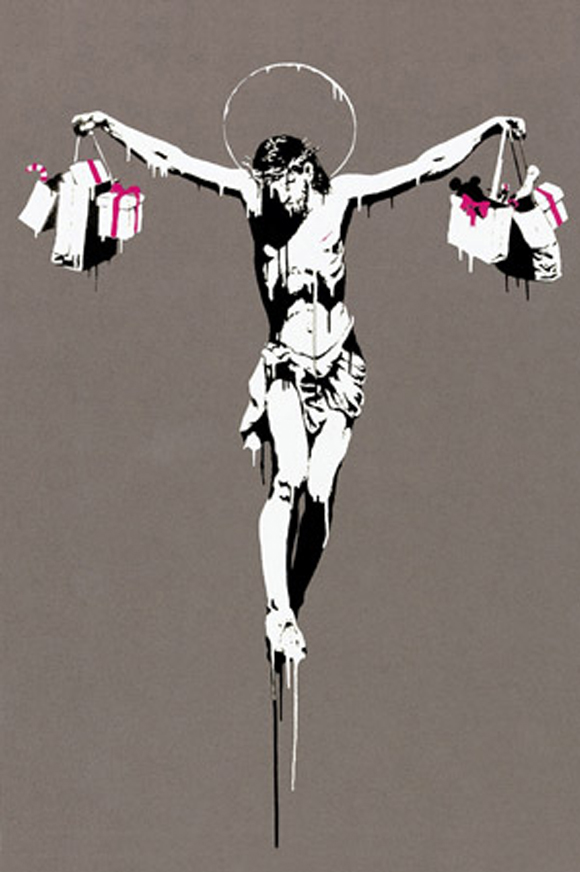 Jesus with shopping bags: In this work Banksy is criticizing the commercialism in society and in particular of Christmas. Rather than being a time of focusing on the Christian values of love, charity, compassion and forgiveness, Christmas has become a time of personal gratification through materialistic consumption. In the shopping bags one can see wrapped presents, a candy cane, and part of a Mickey Mouse doll, emphasizing how this holiday season, which is supposed to celebrate the birth of Jesus, has come to represent consumerism. This contrasts with the teaching of Jesus, who criticized the focus on material things at the expense of moral and spiritual development. The melting objects represent the ephemeral joy brought by material things, and the gray background conveys the gloominess in people’s lives when they are devoid of love, compassion, charity and other intangible values. The crucifixion represents how people sacrifice themselves for material things, which ultimately do not bring satisfaction. Closing notes for Banksy: Art is yet another form of activism! Banksy uses this medium to reach people who might not go to art galleries. Encourage artistic-minded students to use their art as a medium for activism
5) Share Podcast: TED Talk, Everyday Leadership, by Drew Dudley. This short 9 minute podcast is a fantastic way to end the CDL as it talks about the small stuff you can do everyday to serve and to be a leader. Dudley discusses how people think leadership is too big for themselves, that they have to save the world. This humorous witty podcast is very inspirational and a great way to end the discussion on service and activism, bringing it down to the small things in life we can all do day in and day out to make the world a better place.
6) Closure: Personal and Community Letters
- We discussed how service and activism is SO broad and students can become involved in so many different ways. We linked service with gratitude- how we have made a huge effort to cultivate and share gratitude on this trip because that, in its own way, is service, as it makes people feel appreciated, worthy and seen for the good deeds that they do on a daily basis, which encourages them to do more.
- Airplane Letters: The night before, we introduced Airplane Letters and gave every student a slip of paper for each member of the group to write them a personal note, which we then collected to give each student a personal envelope that contained a message from each group member to read once they are back home. We encouraged students to think of “Lollipop moments” from the trip to share/express in the letters to their peers.
- We reiterated how this trip has explored only several of MANY different ways students can become involved in their home communities.
- Letter to Self: We handed back letters that students wrote themselves during orientation and gave them new paper and envelopes to write a letter to themselves that we will mail to them 6 months after the trip once they are all well into college. We encouraged them to talk about the trip, small moments, big moments, and to also include at least one way that they want to get involved at home or at school. Hence, the letter serves as a reminder/way to hold themselves accountable to see if they have gotten involved.
Widening the Circle of Compassion By Pema Chodron, from When Things Fall Apart: Heart Advice for Difficult Times
Only in an open, nonjudgmental space can we acknowledge what we are feeling. Only in an open space where we’re not all caught up in our own version of reality can we see and hear and feel who others really are, which allows us to be with them and communicate with them properly. When we talk of compassion, we usually mean working with those less fortunate than ourselves. Because we have better opportunities, a good education, and good health, we should be compassionate toward those poor people who don’t have any of that. However, in working with the teachings on how to awaken compassion and in trying to help others, we might come to realize that compassionate action involves working with ourselves as much as working with others.
Compassionate action is a practice, one of the most advanced. There’s nothing more advanced than relating with others. There’s nothing more advanced than communication — compassionate communication. To relate with others compassionately is a challenge. Really communicating to the heart and being there for someone else — our child, spouse, parent, client, patient, or the homeless woman on the street — means not shutting down on that person, which means, first of all, not shutting down on ourselves. This means allowing ourselves to feel what we feel and not pushing it away. It means accepting every aspect of ourselves, even the parts we don’t like. To do this requires openness, which in Buddhism is sometimes called emptiness — not fixating or holding on to anything.
Only in an open, nonjudgmental space can we acknowledge what we are feeling. Only in an open space where we’re not all caught up in our own version of reality can we see and hear and feel who others really are, which allows us to be with them and communicate with them properly.
Recently I was talking with an old man who has been living on the streets for the last four years. Nobody ever looks at him. No one ever talks to him. Maybe somebody gives him a little money, but nobody ever looks in his face and asks him how he’s doing. The feeling that he doesn’t exist for other people, the sense of loneliness and isolation, is intense. He reminded me that the essence of compassionate speech or compassionate action is to be there for people, without pulling back in horror or fear or anger.
Being compassionate is a pretty tall order. All of us are in relationships every day of our lives, but particularly if we are people who want to help others — people with cancer, people with AIDS, abused women or children, abused animals, anyone who’s hurting — something we soon notice is that the person we set out to help may trigger unresolved issues in us. Even though we want to help, and maybe we do help for a few days or a month or two, sooner or later someone walks through that door and pushes all our buttons.
We find ourselves hating those people or scared of them or feeling like we just can’t handle them. This is true always, if we are sincere about wanting to benefit others. Sooner or later, all our own unresolved issues will come up; we’ll be confronted with ourselves. Roshi Bernard Glassman is a Zen teacher who runs a project for the homeless in Yonkers, New York. Last time I heard him speak, he said something that struck me: he said he doesn’t really do this work to help others; he does it because he feels that moving into the areas of society that he had rejected is the same as working with the parts of himself that he had rejected.
Although this is ordinary Buddhist thinking, it’s difficult to live it. It’s even difficult to hear that what we reject out there is what we reject in ourselves, and what we reject in ourselves is what we are going to reject out there. But that, in a nutshell, is how it works. If we find ourselves unworkable and give up on ourselves, then we’ll find others unworkable and give up on them. What we hate in ourselves, we’ll hate in others.
To the degree that we have compassion for ourselves, we will also have compassion for others. Having compassion starts and ends with having compassion for all those unwanted parts of ourselves, all those imperfections that we don’t even want to look at. Compassion isn’t some kind of self-improvement project or ideal that we’re trying to live up to. There’s a slogan in the mahayana* teachings that says, “Drive all blames into oneself.” The essence of this slogan is, “When it hurts so bad, it’s because I am hanging on so tight.” It’s not saying that we should beat ourselves up. It’s not advocating martyrdom.
What it implies is that pain comes from holding so tightly to having it our own way and that one of the main exits we take when we find ourselves uncomfortable, when we find ourselves in an unwanted situation or an unwanted place, is to blame. We habitually erect a barrier called blame that keeps us from communicating genuinely with others, and we fortify it with our concepts of who’s right and who’s wrong. We do that with the people who are closest to us, and we do it with political systems, with all kinds of things that we don’t like about our associates or our society.
It is a very common, ancient, well-perfected device for trying to feel better. Blame others. Blaming is a way to protect our hearts, to try to protect what is soft and open and tender in ourselves. Rather than own that pain, we scramble to find some comfortable ground. This slogan is a helpful and interesting suggestion that we could begin to shift that deep-seated, ancient, habitual tendency to hang on to having everything on our own terms. The way to start would be, first, when we feel the tendency to blame, to try to get in touch with what it feels like to be holding on to ourselves so tightly.
What does it feel like to blame? How does it feel to reject? What does it feel like to hate? What does it feel like to be righteously indignant? In each of us, there’s a lot of softness, a lot of heart. Touching that soft spot has to be the starting place. This is what compassion is all about. When we stop blaming long enough to give ourselves an open space in which to feel our soft spot, it’s as if we’re reaching down to touch a large wound that lies right underneath the protective shell that blaming builds.
Buddhist words such as compassion and emptiness don’t mean much until we start cultivating our innate ability simply to be there with pain with an open heart and the willingness not to instantly try to get ground under our feet. For instance, if what we’re feeling is rage, we usually assume that there are only two ways to relate to it. One is to blame others. Lay it all on somebody else; drive all blames into everyone else. The other alternative is to feel guilty about our rage and blame ourselves. Blame is a way in which we solidify ourselves.
Not only do we point the finger when something is “wrong,” but we also want to make things “right.” In any relationship that we stick with, be it marriage or parenthood, employment, a spiritual community, or whatever, we may also find that we want to make it “righter” than it is, because we’re a little nervous. Maybe it isn’t exactly living up to our standards, so we justify it and justify it and try to make it extremely right.
We tell everybody that our husband or wife or child or teacher or support group is doing some sort of peculiar antisocial thing for good spiritual reasons. Or we come up with some dogmatic belief and hold on to it with a vengeance, again to solidify our ground. We have some sense that we have to make things right according to our standards. If we just can’t stick with a situation any longer, then it goes over the edge and we make it wrong because we think that’s our only alternative. Something’s right or something’s wrong.
We start with ourselves.
We make ourselves right or we make ourselves wrong, every day, every week, every month and year of our lives. We feel that we have to be right so that we can feel good. We don’t want to be wrong because then we’ll feel bad. But we could be more compassionate toward all these parts of ourselves. When we feel right, we can look at that. Feeling right can feel good; we can be completely sure of how right we are and have a lot of people agreeing with us about how right we are.
But suppose someone does not agree with us? Then what happens? Do we find ourselves getting angry and aggressive? If we look into the very moment of anger or aggression, we might see that this is what wars are made of. This is what race riots are made of: feeling that we have to be right, being thrown off and righteously indignant when someone disagrees with us.
On the other hand, when we find ourselves feeling wrong, convinced that we’re wrong, getting solid about being wrong, we could also look at that. The whole right and wrong business closes us down and makes our world smaller. Wanting situations and relationships to be solid, permanent, and graspable obscures the pith of the matter, which is that things are fundamentally groundless.
Instead of making others right or wrong, or bottling up right and wrong in ourselves, there’s a middle way, a very powerful middle way. We could see it as sitting on the razor’s edge, not falling off to the right or the left. This middle way involves not hanging on to our version so tightly. It involves keeping our hearts and minds open long enough to entertain the idea that when we make things wrong, we do it out of a desire to obtain some kind of ground or security.
Equally, when we make things right, we are still trying to obtain some kind of ground or security. Could our minds and our hearts be big enough just to hang out in that space where we’re not entirely certain about who’s right and who’s wrong? Could we have no agenda when we walk into a room with another person, not know what to say, not make that person wrong or right? Could we see, hear, feel other people as they really are? It is powerful to practice this way, because we’ll find ourselves continually rushing around to try to feel secure again — to make ourselves or them either right or wrong. But true communication can happen only in that open space.
Whether it’s ourselves, our lovers, bosses, children, local Scrooge, or the political situation, it’s more daring and real not to shut anyone out of our hearts and not to make the other into an enemy. If we begin to live like this, we’ll find that we actually can’t make things completely right or completely wrong anymore, because things are a lot more slippery and playful than that. Everything is ambiguous; everything is always shifting and changing, and there are as many different takes on any given situation as there are people involved.
Trying to find absolute rights and wrongs is a trick we play on ourselves to feel secure and comfortable. This leads to a bigger underlying issue for all of us:
- How are we ever going to change anything?
- How is there going to be less aggression in the universe rather than more?
- We can then bring it down to a more personal level: how do I learn to communicate with somebody who is hurting me or someone who is hurting a lot of people?
- How do I speak to someone so that some change actually occurs?
- How do I communicate so that the space opens up and both of us begin to touch in to some kind of basic intelligence that we all share? In a potentially violent encounter, how do I communicate so that neither of us becomes increasingly furious and aggressive?
- How do I communicate to the heart so that a stuck situation can ventilate? How do I communicate so that things that seem frozen, unworkable, and eternally aggressive begin to soften up, and some kind of compassionate exchange begins to happen?
Well, it starts with being willing to feel what we are going through. It starts with being willing to have a compassionate relationship with the parts of ourselves that we feel are not worthy of existing on the planet. If we are willing through meditation to be mindful not only of what feels comfortable, but also of what pain feels like, if we even aspire to stay awake and open to what we’re feeling, to recognize and acknowledge it as best we can in each moment, then something begins to change.
Compassionate action, being there for others, being able to act and speak in a way that communicates, starts with seeing ourselves when we start to make ourselves right or make ourselves wrong. At that particular point, we could just contemplate the fact that there is a larger alternative to either of those, a more tender, shaky kind of place where we could live.
This place, if we can touch it, will help us train ourselves throughout our lives to open further to whatever we feel, to open further rather than shut down more. We’ll find that as we begin to commit ourselves to this practice, as we begin to have a sense of celebrating the aspects of ourselves that we found so impossible before, something will shift in us. Something will shift permanently in us.
Our ancient habitual patterns will begin to soften, and we’ll begin to see the faces and hear the words of people who are talking to us. If we begin to get in touch with whatever we feel with some kind of kindness, our protective shells will melt, and we’ll find that more areas of our lives are workable. As we learn to have compassion for ourselves, the circle of compassion for others — what and whom we can work with, and how — becomes wider.
 Julia Lang Portfolio