The above video is one of the students projects completed on the National Geographic Student Expedition trip to Costa Rica (2013)
July, 2013
This summer, I had the remarkable opportunity to lead American high school students on a two-week long Community Service trip in Costa Rica for National Geographic Student Expeditions. I was fascinated by how service and travel under the umbrella of the ubiquitous magazine might be different, and what I could learn and add to my tool-kit as an experiential and internationally-interested educator, teacher, and student affairs practitioner.
While I was scoping out a community service trip in Costa Rica for National Geographic Student Expeditions, I would find myself perched on a wooden stool at a dirt floor little food “soda” three hours off of the Pan American highway, planning a menu with a local Tico who had never set foot outside of their tiny town, let alone Costa Rica, or drifting into conversation with a high school student seated next to me on a public bus. Every single one of these people had heard of National Geographic and was excited to meet me, an ambassador of the magazine.
National Geographic perhaps has the most influence and power over young children, their tiny hands leafing through the pages, eyes glossing over words but bulging at images of creatures from every corner of the world, deepest depths of the sea and far reaches of outer space. As a child, I would make collages from the pictures in the magazine and as I became an adolescent and adult, the images I saw in National Geographic continually inspired me to learn more about a world of which I was completely unaware, living an isolated American life. Clearly, I was not alone, as National Geographic has captivated people around the world for decades and it is estimated that the magazine reaches 450 million people a month.
I have personally participated in and led multiple service-learning and international programs in high school, college, and graduate school, where I was the Graduate Assistant in the Center for Civic Engagement. In this role, I was responsible for creating, planning and executing our entire alternative break program, where groups of students participated in educational service trips during school breaks. While I have been steeped in service-learning for years now, I was eager to see how service and travel was framed under National Geographic and how this job would expand the view that I had of service and enhance my ability to facilitate transformative learning experiences for students.
Thanks to the universal presence of the magazine, I found that National Geographic has a unique and powerful lens on student travel: the “Nat Geo spirit” as it is lovingly called by veteran staff and cultivated by leaders in young travelers.
The National Geographic training in rural Vermont united 60 leaders and experts that would guide photography, biodiversity and wildlife conservation, community service, and creative writing trips to countries ranging from Tanzania, Greece, Iceland, New Zealand, Brazil, and China, to name a few. Throughout training, we continuously discussed the “Nat Geo spirit” and how a trip through Nat Geo was different from ones we might have led in the past.
What comes to mind when you think of National Geographic? How is it different from other travel magazines, which might highlight luxurious resorts and travel packages? The glossy pages of the magazine do not tell you where to find the most pristine infinity pool while enjoying a Thai massage—rather, they capture wild animals in their natural habitat, reveal untold stories of people or creatures nobody has yet explored, and honor meticulous research that promotes conservation and education.
So how is this translated into a study travel and community service program?
The very first morning after students arrived in Costa Rica, we laid out a big blank white poster board on the floor and with faces looming over and voices chirping in, we had students brainstorm what it meant to travel under the umbrella of National Geographic, and what the “Nat Geo spirit” might entail. As students tossed out ideas, we scribbled them down: witness, conservation, adventurer, documentation, photography, science, natural habitat, preservation, pioneer, diversity, education.
As our conversation developed and grew, we honed it down to one key phrase: As a participant on a National Geographic trip, you are a traveler and an explorer, not a tourist.
Your aim is to witness, honor, and document difference, not try to change or modify it to fit your worldview, cultural assumptions, or within the boundaries of your comfort level.
With the service component and focus of our trip, this took on a whole new meaning. Our goal was not to swoop in and “save those poor people,” but rather to come as humble students of the world who sought to learn about something new by examining and appreciating what we found in its local context, such as food, how people treat time, roads, homes, religious views, political views, natural habitats, etc.
The Nat Geo spirit dives deeper into authentic and personal documentation of what this spirit allows us to discover. As writers of the magazine take beautiful photographs and write spellbinding stories of their experience, our students were challenged to create an artifact of their journey and learning in some way through an individual project. We planted this seed early on during orientation at the beach. Once we arrived at our community service village, students slept on the tile floor in an open air community center, mosquito nets draped over tin tables with students sleeping beneath while beetles and moths gathered around in droves and the sunrise woke us up at dawn. The perfect time to remind the group of the Nat Geo spirit and refocus on the idea of traveling with this lens and finding a way for each of us to document our discomfort, our insight, our learning. Again, the poster board came out and we brainstormed what this might look like: photographs, poems, videos, painting a striking scene, learning how to cook a meal, investigating and reporting on a particular aspect of the community, exploring the local flora and fauna, learning a new skill with someone in the community and documenting it in some way, perhaps interviewing a community member and writing an expose.
I had never taken this angle with a service project before. Sure, I had kept a group journal, facilitated nightly reflection and switched it up here and there with a creative reflection, handing out paper and markers and asking students to draw a picture representing a powerful insight from their day. Yet, never before had I jointly focused on the group’s learning as a whole, and on unique individual projects.
We helped students hone in on a particular social issue, community asset or aspect, or even a way for them to document their part in a community-service project completed during the trip. In this way, students gained insight into a particular point of interest, sharpened their photography, writing, critical thinking and/or technology skills, while also creating an artifact to share with friends and family and to remind themselves of what they did, what they learned, and even who they were during that particular point in their life.
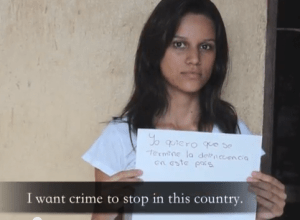
Photo is a snapshot from video above by National Geographic Student Expeditions participant, Bethany Somes, as her final project on the Costa Rica Community Service trip (2013l)
By challenging students to spearhead an individual project and supporting them throughout the process via proper instruction and mentoring, thoughtful, meaningful projects have the potential to greatly enhance student learning. Students benefit from intentional and individual intercultural contact, continual opportunity for personalized reflection, greater communication and language skills, and critical thinking abilities.
Short-term service-learning experiences are often powerful, eye-opening experiences for students, but it is all too easy for students to retreat back into their previous and comfortable mindsets. By explicitly developing the idea of students as explorers, scientists, and artists capable of producing powerful, tangible artifacts of their journey, students not only gain more from their experience, but also have a tangible reminder of their transformative experience in the future. Previous individual projects can also serve as powerful pre-education and fundraising tools as they give life and voice to the deep impact experiential experiences have on students, communities, and educators. At the end of the trip, a gallery or showing of the projects is a remarkable reflection tool and powerful way for the group to come together as whole to celebrate and honor everything that we saw, did, and created.
Through leading international community service trips with National Geographic, I learned how cultivating the “Nat Geo spirit” and challenging students to create tangible individual projects are extraordinary tools for teaching students how to travel in a more culturally sensitive, environmentally conscious, and sustainable fashion, while also enriching the entire experience for individual students and the group as a whole.
I encourage other practitioners to develop a culture of travel, even if your experiential trip is just down the road, and challenge your students to imagine, create and share a tangible artifact of their exploration and learning.
Originally published July 17, 2013 on criticalserviceleaning.org
 Julia Lang Portfolio